
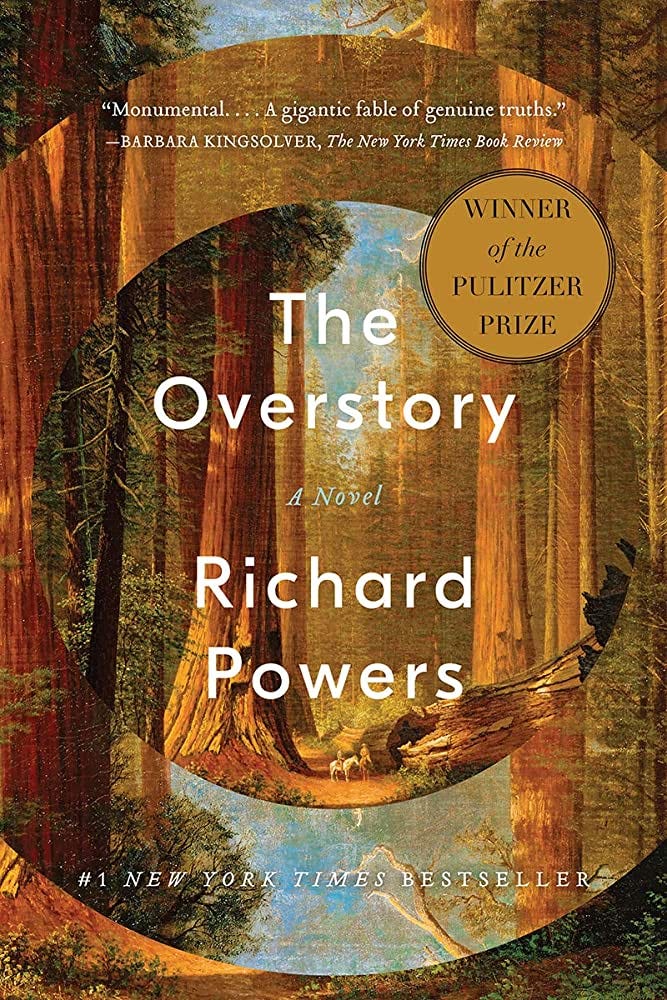
The Overstory
Richard Powers

“You and the tree in your backyard come from a common ancestor. A billion and a half years ago, the two of you parted ways. But even now, after an immense journey in separate directions, that tree and you still share a quarter of your genes…” (page 443)
Richard Powers, author of The Overstory, loves trees. That much is obvious from the quote I began this short blog with. The Overstory is about so much more than trees, however.
Powers wrote this brilliant novel like a tree stump reveals its rings: showing its age and the elements around it. The outer ring of the stump is a long circle, varying in thickness with the rings as you move towards the center of the stump, but it’s by far the longest. So too is the beginning of the book. He intentionally designed the book to move like you would read the years and story of a cut down tree.
Imagine, though, that the rings of this stump interlocked. To be frank, I’m no expert dendrologist, nor do I play one on TV. But Powers follows the life of a professional dendrologist, as well as amateurs in the field. Each character lives their own life, in their own respective spheres, and the time lapse is rather short, but the stories are elongated (again, like the outer rings of a tree). As you move from section to section (there are four), the stories are shortened, and you begin noticing what the biblical studies guild likes calling, “intertextualities.” It’s a fancy word for: the stories allude to one another and begin interlocking various motifs/themes.
As I previously mentioned, it’s mesmerizing. You get lost in each story, but you follow each one. Each story starts quickening time as you get further into the book, much as the inner rings of the tree may tell the story of a longer time period but are shorter “memories.” The way Powers interlocks these stories is incredible, creative in a way that a class TV series might do the same with each major character throughout each season.
Furthermore, Powers is a master of illustration. I’ll qualify that a little further. A good preacher can deliver a gospel-centered sermon, and use illustrations that are helpful to apply the message/theme/verse, etc. Usually, though, you might remember the illustration or the point/application being made, but rarely both. A great preacher uses illustrations not to add to the point being made, but to vividly deliver it to your senses. You don’t feel it’s another thing being said (like, “Oh, he’s providing an illustration”), but so executes the illustration that when you go home, you cease thinking, “Great point, and good illustration,” but the illustration and point become one. It neither adds nor takes anything away, but imprints it. That’s what Powers does with his illustrations. They’re beautifully well done, like the old-school Microsoft screensaver when the object perfectly hits the corner (did I do it well?).
Anyways, if you want to read a master at his craft, interlock stories in a way that detracts from none, but adds to all, while laughing a whole lot and learning a little bit about trees, I highly recommend The Overstory. Maybe Richard (we’re on a first name basis, you know) will teach you a thing or to; he did for me.
Read great books!
Next week: Buying physical books at a physical bookstore.